Discover expert articles, maintenance guides, and market developments from TWF Auto Part Co., Ltd.
In-depth technical knowledge and export guidance for Bajaj, TVS King, and APE Piaggio platforms.
Choosing the right Bajaj Compact Three Wheeler Brake Hose affects braking response, maintenance costs, and driver confidence. These small commercial vehicles often work on crowded streets, uneven roads, and demanding delivery routes. Their brake hoses face repeated flexing, heat, dust, moisture, and pressure changes. A weak hose may show cracks, swelling, leakage, or delayed braking. Small details matter.
This guide examines ten leading Bajaj Compact Three Wheeler Brake Hose brands through practical selection criteria. These include material quality, pressure resistance, fitting accuracy, corrosion protection, service availability, and warranty support. Brake-system consultant Ravi Mehta explains, “A brake hose should remain reliable when the road, load, and weather become unpredictable.” That principle guides this comparison. It also reflects workshop experience, where a correctly fitted hose can prevent repeated repairs and unnecessary downtime.
Brand reputation alone is not enough. Some products look similar but use different rubber compounds, reinforcement layers, or connector finishes. Fitment can also vary between vehicle versions and production years. Buyers should verify the vehicle model, hose length, end fittings, and operating specifications before ordering. This review does not treat every market claim as fact. Product quality can change between batches, regions, and suppliers. That deserves attention.
The selected brands are evaluated for dependable performance rather than marketing language. We consider feedback from mechanics, replacement patterns, technical documentation, and everyday operating conditions. The ranking may not suit every fleet. Still, it offers a practical starting point for workshops, parts distributors, and Bajaj three-wheeler owners seeking safer, more consistent braking performance.
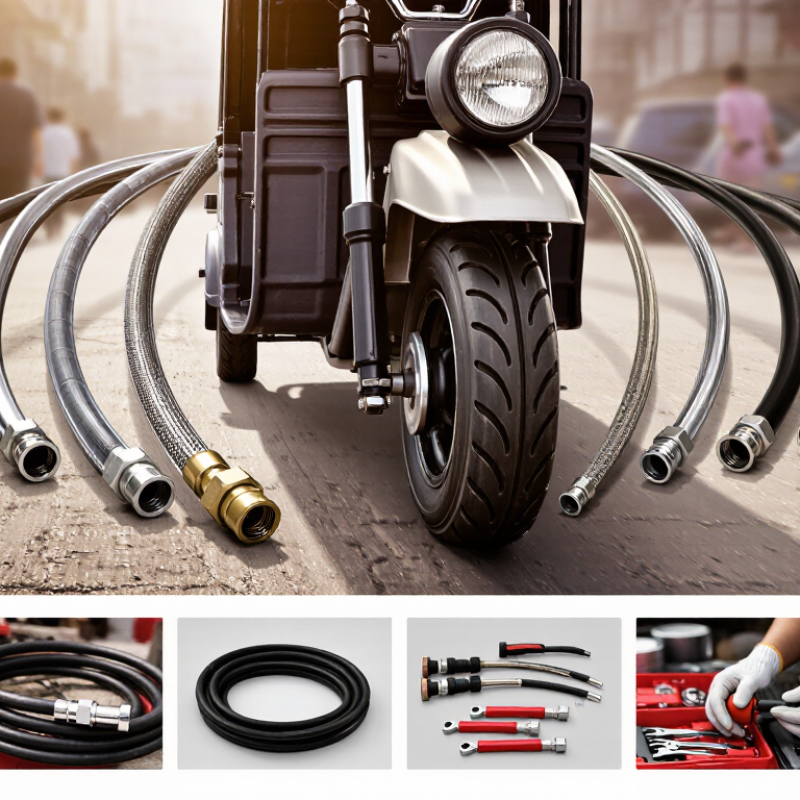
China’s compact three-wheeler brake hose market covers original equipment, replacement parts, and export-oriented supply. It serves urban delivery vehicles, rural transporters, and light commercial fleets. The scope is broader than factory assembly.
Manufacturers commonly produce hoses with rubber tubes, textile reinforcement, metal fittings, and protective sleeves. Buyers usually inspect length, thread accuracy, pressure resistance, bend performance, and corrosion protection. A practical check includes repeated flexing, leakage testing, and inspection after heat exposure. Small details matter. A fitting that sits slightly off-center can complicate installation.
The market also includes mold development, batch traceability, packaging, and technical support. Suppliers near major manufacturing clusters often respond faster to custom dimensions and mixed-volume orders. Replacement distributors may prefer standard hose sizes, while export buyers often request documented testing and tailored connectors. Field experience shows that dusty roads, sharp turns, and frequent braking can shorten service life. Yet climate and driving habits vary widely, so one specification cannot fit every region. A weakness in many market comparisons is limited attention to after-sales failure records. Better evaluations should track leakage complaints, return rates, and installation feedback over time. Cost remains important, but unstable materials can create higher maintenance expenses.
This chart uses China's annual motorcycle production as a public market proxy for brake-hose demand. Three-wheeler-specific brake-hose volumes and supplier rankings are not separately disclosed in national statistics, so no company or brand-level data is shown.
The production data indicates the addressable vehicle-component market expanded from 2019 to 2022, supporting demand for replacement and original-equipment brake hoses across compact motorcycle and three-wheeler applications. Source: publicly reported annual figures from the China Motorcycle Chamber of Commerce and industry releases.
A reliable top-ten comparison should begin with test evidence, not advertising claims. For compact three-wheelers, brake hoses face heat, vibration, sharp steering movement, and repeated pressure changes. SAE J1401 testing can help assess burst strength, whip resistance, tensile performance, and dimensional stability. These details matter near a small front wheel.
FMVSS 106 adds practical checks for leakage, expansion, assembly strength, and hose identification. ISO 4926 references hydraulic brake-system fluid compatibility and performance conditions. A qualified supplier should provide dated laboratory reports, sample numbers, test fluids, and clear acceptance results. Generic certificates are not enough. In my experience, missing test conditions often create false confidence.
Tips: Request test reports for the exact hose construction. Check inner-tube material, reinforcement layers, fittings, and bend radius. Compare results after aging, not only before it. Ask for production-batch traceability. Small details matter.
A useful ranking should also examine production consistency, inspection records, and technical response speed. Ten suppliers may appear similar on paper, yet their hose expansion can differ under pressure. That difference affects pedal feel and braking control. No test file is perfect. I would still question reports without raw data, retest dates, or failure observations. Field samples should confirm laboratory results across heat, moisture, and vibration.
China Top 10 Bajaj Compact Three Wheeler Brake Hose Brands?
A reliable ranking should measure more than price or appearance. The top ten candidates are assessed through pressure resistance, burst strength, flexibility, and service life. FMVSS 106 requires hydraulic brake hose assemblies to withstand a 4,000 psi burst test without rupture. SAE J1401 also emphasizes controlled expansion under pressure. These figures provide a useful technical baseline.
Pressure stability matters during repeated urban braking. A hose with excessive expansion can create a soft lever feel. Burst strength reveals how much safety margin remains after aging. Flexibility is tested through bending, twisting, and temperature cycling. SAE test procedures commonly examine performance after thousands of movement cycles. Service life depends on rubber compound, reinforcement quality, fitting accuracy, heat, dust, and brake-fluid compatibility. Field inspections often reveal small cracks near the fittings first. No ranking is perfect. Laboratory results may not match overloaded vehicles, rough roads, or poor installation.
Tips: Check the hose after 20,000 to 30,000 kilometers, especially in hot or dusty areas. Look for swelling, surface cracks, leakage, or twisted fittings. Compare pressure expansion data, not only burst numbers. A hose may pass a short test but age badly. Confirm compliance with FMVSS 106, SAE J1401, or applicable local standards before installation. Keep service records with mileage, operating conditions, and replacement dates.
China’s Top 10 Bajaj Compact Three-Wheeler Brake Hose Brands are often judged by safety, consistency, and practical service. In this market, leading suppliers usually combine reinforced rubber, corrosion-resistant fittings, and accurate end connections. These details matter when a vehicle works daily on crowded streets or uneven rural roads.
A dependable brake hose should tolerate heat, vibration, moisture, and repeated bending. Experienced manufacturers test burst pressure, leakage, aging, and dimensional accuracy before shipment. They also inspect crimping points closely. Small defects can become serious maintenance problems. Some suppliers provide hoses for different layouts, including front, rear, and hydraulic line applications. Clear drawings and sample confirmation reduce fitting errors.
The strongest Chinese suppliers usually maintain stable production records and traceable inspection reports. They can discuss material grades, working pressure, minimum bend radius, and packaging protection with confidence. This reflects real technical knowledge, not just sales language. Still, no ranking is perfect. A factory may offer excellent hoses but respond slowly to custom requests. Another may provide competitive pricing but need stronger documentation. Buyers should compare test evidence, delivery history, replacement support, and field feedback before choosing among the top ten. Practical inspection remains necessary. Specifications alone can mislead.
China’s leading compact three-wheeler brake-hose suppliers should be judged beyond price and catalog size. Compliance comes first. Buyers should request batch-level evidence for SAE J1401, ISO 9001 systems, and applicable vehicle brake regulations. Test records should cover burst pressure, whip resistance, leakage, salt spray, and temperature cycling. A hose may look identical, yet a slightly incorrect thread can cause dangerous installation errors.
Fitment accuracy needs physical verification. Check banjo angles, hose length, end-fittings, thread pitch, and sealing washers against the original assembly. Field experience shows that a two-millimeter length difference can create rubbing near suspension parts. Digital drawings help, but samples remain necessary. Sometimes, the drawing is wrong.
Warranty terms reveal supplier confidence. Strong policies define mileage, service period, inspection procedures, and responsibility for rejected batches. Buyers should also examine traceability, production dates, and retained samples. A low claim rate is useful, but unpublished warranty data deserves caution. Independent inspection is still valuable.
Export capability requires more than shipping experience. The World Bank’s 2023 Logistics Performance Index ranked China 19th globally, with a score of 3.7, supporting its strong logistics base. UNCTAD’s Review of Maritime Transport reports that shipping carries over 80% of global merchandise trade by volume. However, exporters must prove packaging strength, documentation accuracy, customs knowledge, and replacement-part availability. Compare the top ten candidates using compliance files, measured fitment results, warranty clarity, and delivery records. Fancy brochures cannot replace evidence.
It helps assess burst strength, whip resistance, tensile performance, and dimensional stability. These tests matter near a vibrating front wheel. Marketing claims are not enough.
Request the exact hose construction, sample number, test fluid, test date, and acceptance result. Ask for raw data and failure observations. A generic certificate creates false confidence.
It covers leakage, expansion, assembly strength, and hose identification. These checks show whether the hose remains stable under pressure. Field testing should confirm laboratory results.
It addresses hydraulic brake-fluid compatibility and related performance conditions. Check whether the tested fluid matches the vehicle’s requirements. That detail is easy to overlook.
Compare hose length, banjo angle, thread pitch, fittings, and sealing washers with the original assembly. A two-millimeter difference may cause rubbing near suspension parts. Digital drawings help. Samples matter more.
Brake hoses experience heat, moisture, vibration, salt exposure, and repeated pressure changes. Compare results before and after aging. I would question reports showing only fresh samples.
Look for mileage limits, service periods, inspection procedures, rejected-batch responsibility, and retained samples. Production dates and batch traceability are equally useful. Low claim rates alone prove little.
Review packaging strength, customs documents, delivery records, and replacement-part availability. Shipping experience does not guarantee accurate paperwork. Small documentation errors can delay replacement parts.
This article presents a practical evaluation of China’s Bajaj Compact Three Wheeler Brake Hose market, focusing on products designed for compact three-wheelers and their specific braking requirements. It explains how manufacturers and buyers can assess hose quality through SAE J1401, FMVSS 106, and ISO 4926 testing principles, including pressure resistance, burst strength, flexibility, dimensional stability, and long-term service performance. The discussion establishes a clear market scope covering material selection, construction quality, application compatibility, and production consistency.
A structured top-ten comparison then ranks suppliers according to technical performance, fitment accuracy, service life, quality control, warranty support, and export capability. Rather than relying only on price or appearance, the evaluation emphasizes verifiable specifications, reliable connection dimensions, resistance to heat and vibration, and stable braking performance under demanding operating conditions. The summary also highlights how compliance documentation, inspection procedures, and after-sales support can help buyers select a dependable Bajaj Compact Three Wheeler Brake Hose for different markets and vehicle applications.